Friday, February 8, 2019

HA3051 Accounting Theory sample

HA3051 Accounting theory Sample Assignment

Accounting theory

Abstract

Accounting theories are very important tools in making decisions that involve the accounts and a lot of finances, these theories also help in providing guidelines for accounting decisions. BP group operation in the Mexican gulf can to a stop when its oil field prospect exploded and caused oil spillage in the Mexican Gulf. The Transocean Company was in charge of the operations, although it was only BP that took responsibility for paying the damages of this accident. It is noted that BP adhered to the Legitimization theory which requires a company to adhere to the norms and value of the society in which it operates

Introduction         

There is always a reason behind every action that a man or a company takes; these actions are always supported by sound reasons. Companies are always extra cautious, especially when taking a financial or accounting process and therefore the there are theories that man has come up with to help and provide guidelines towards decision-making process (Most, 1977).  It should be noted that for accounting decisions, accounting theories are very important in guiding or explaining these decisions. This paper will, therefore, focus on the accounting theories and how the BP group applied the theory during the deepwater horizon oil spill.

The brief overview of BP’s oil spillage
Bp oil spill, also known as Gulf of Mexico Spill or the Deepwater Horizon oil spill is the largest marine oil spill in US history. This catastrophe is a resultant of an explosion on the deep sea horizon along the offshore of the oil platform which a way off 50 miles South East of the River Mississippi Delta. Although the BP Corporation tried to stop the leak it did not succeed but its success in stopping the leak is when it opted to cap the well, unfortunately, the damage was beyond measure and oil had spilled into the Mexican Gulf for eighty-six days. Although the oil spill had been stopped the impact of its damages were devastating and therefore it arose intense debate and the many interested parties deliberated on the issue. It is speculated that the oil released to the Gulf of Mexico from the PB’s Macon do well was roughly over five million barrels of oil in which the Gulf of Mexico directly receiving 4.2 million barrels.  The damage estimated was huge and the from the satellite pictures it’s estimated that the total coverage of the oil spill was 68,000 square miles (Houdet & Germaneau, 2011).
Although the Transocean Ltd owned Deepwater Horizon was contracted by PB tasked with the duty of drilling an exploratory well but it is the PB who were the principal owners and developers of the Macon do oil well prospect where the catastrophic accident occurred.  Both BP and Deepwater were aware at a process of shutting down the well so that they can prepare for future mining while another contracted company, the Halliburton had completed the task of cementing the casings of the well. The US government intervened and in its verdict, BP was to take sole responsibility of the b damage and tasked with the duty of cleaning up the oil spill from the ocean. Although the BP Company did not decline the responsibility it later felt that both the Halliburton and Transocean should be responsible too since they are partly to blame (Houdet & Germaneau, 2011).
BP’s response to this accident had some serious financial implication because it had to release a large group income. It is this company released a pre-taxed amount of US$ 40.9 billion to cater for the damages the occurred due to the Deepwater Horizon oil spill, and in from this amount, a  total of US$17.7 billion was spent in the year 2010 alone.  The BP Company had to spend. The Bp as part of generating this amount the BP group had to 0-raise US$20 billion from the sale of its assets in the US over a period of 3.5 years, these funds will satisfy all the legitimate claims that will be demanded by the independent Gulf Coast Claims Facility, litigations settlements, natural resource damage costs and local and state response costs. The group will fund a ten-year research program at a cost of US$500 million that will study the impact of oils spills into Mexican gulf and the effect on the marine and shoreline ecosystem (Houdet & Germaneau, 2011).
Theoretical framework
The theory is a structure that plays the role of uniting the underlying logic or system of reasoning, therefore Accounting theory is logical reasoning in the form of a set of broad principles that give a provision of general frame of reference by which accenting practices can be evaluated and guide the evaluation of new procedures and practices. The accounting theory incorporates fundamental assumptions, definitions, principles and concepts and the methods used to arrive at their definitions. The process of solving an accounting issue requires a person to have absolute expertise and well acquaintance in theoretical knowledge and a backup of sufficient practical experience. Like any other theory, accounting theory is based on sound reasoning and incorporates a logical and confirmed hypothesis that happens to be accepted by all. There exist a close interaction between accounting theory and the practice of account in a way that separation of the two improves to be a difficulty. The process of developing the theories of accounting involves observation, analysis, explanations, scrutiny, and scanning of the daily practice of accounting.
To best suit, the explanation of BP’s case of oil spillage, Legitimacy theory of accounting can suit this scenario. This theory can vaguely suit a description that businesses are liable to social contracts in which the farms agree to perform a variety of socially desired actions in return for the approval of its goals and other gains, and by this, its existence is guaranteed (Ventureline, 2016). Legitimacy theory is one of the corporate strategy theories that is most cited and closely related to public relations theories. To understand this theory is important to expound on the term legitimacy, which refers to a generalized perception that, actions of an organization are justified within a given social system? In an organizational context, legitimacy exists when organizational objectives, outputs and operational methods are in compliance with the value and norms of the larger societal system of which the organization is part of it (Wilson,2002). The basic argument of the legitimacy theory is an organization pursue legitimized activities due to the influence the external aspects of the administration. An organization that applies this theory ensures that its actions are based on the norms, culture and being legitimate with the society and therefore, ensuring its actions are legitimate and acceptable by society. The organization will disclose its environmental information as motivated but this theory; it will also bus PR as a tool to legitimize its activities. This theory describes how an organization with all its mechanisms, operations and structures has gained acceptance in the society (Glautier, & Underdown, 1976). Legitimization has several basic strategies which include;
  1. Adjust the perception of the relevant public without adjusting the behavior of the organization.
  2. Inform and educate the society on the adjustments of the organizations’ activities and performances
  • Adjust the external expectations of organizational performance
  1. Manipulate the public’s perception by deflecting the focus from the fundamentals issue of concern to other related issues by appealing to the masses (Riahi-Belkaoui, 1981).
Analysis
BP group is a multinational company and for it in handling the Deepwater Horizon oil spill accident, it took all the responsibility for the damages that resulted from the oil spill, this company incurred the losses at the expense of selling it the US asserts to cater for the damages and the litigation claims and even to sponsor the research on the ecosystem and lastly it also invested majorly on the cleanup process to get rid of the oil spill from the Mexican Gulf. It is noted that this farm applied the legitimacy theory of social and environmental accounting (Houdet & Germaneau, 2011).
The BP group had to take responsibility for the oil spill to legitimize its activities with the people of the alongside the cost of Louisiana and the Mexican bay. To foster its image and its principles of operation, the company had to take sole responsibility for the oil spill even though two other companies were involved in the accident. BP also made sure the public is educated on the damages its actions had caused by setting up funds to cater for ten-year research into the damages its operations had caused. BP sought societal approval in line with the legitimacy theory by setting aside funds that will compensate for the damages caused by the oil spills. It can be concluded that the BP Company honored the requirements of the Legitimacy theory by seeking approval of the society and taking responsibility for its actions (Houdet & Germaneau, 2011)
The BP group agreed with the legitimacy theory, by adjusting the expectations of its performances to suit the interest of the public which it had caused damages. This company’s operations in the United States incurred serious damages and losses but because of its legitimization, it had to sacrifice its US assets to cater for the damages it had caused to the society an nd environment. Although the company’s operation is to make a profit, its societal norms and values bind the company to fulfill the demands of the society (Houdet & Germaneau, 2011).
BP adhered to the legitimacy theory by changing the relevant public perception without adjusting its practice behavior. This company continued in its operations of oil exploration in other areas while in the Mexican gulf it had to fulfill the demands of the relevant public. The government found BP solely responsible, but because this group is bounded by the regulations in the legitimacy theory, the company had to comply with the demands even though there were two other companies that could take responsibility (Houdet & Germaneau, 2011)
Conclusion
The legitimacy theory bounds a company to the norms and values of the people around its area of operations. The organization will formulate its goals and targets in a way that will ensure a good relationship is fostered with the public are located. Implementation of this policy requires that the company to consider the interest of relevant people, among whom it has to educate about their activities and procedures.
The BP group can be commended as a perfect example of a legitimized company, its operations and actions is justified by how it responded on the deepwater spillage, it made all the efforts to rectify its damages and compensate the society around its operations. BP Company can be commended on the efforts it made to legitimize its actions even though it these actions cost it billions of asserts but it complied with consequences to clear its name and maintain a good perception with the relevant public
References
Glautier, M. W. E., & Underdown, B. (1976). Accounting theory and practice. London: Pitman.
Houdet, J & Germaneau. (2011). The financial impacts of BP’s Response to the deepwater horizon oil spill. Comparing damage valuation approaches & highlighting the need for more reliable environmental accounting and reporting. Case study 2011, Synergy. –A@L Integrated sustainability services, P5
Most, K. S. (1977). Accounting theory. Columbus, Ohio: Grid.
Riahi-Belkaoui, A. (1981). Accounting theory. New York: Harcourt Brace Jovanovich.
Wilson, H. T. (2002). Capitalism after postmodernism: Neo-conservatism, legitimacy and the theory of public capital. Leiden: Brill
visit at: hi5015 legal aspects of international business and enterprise
https://thebestassignmenthelp.com/hi5015-legal-aspects-of-international-business-and-enterprise-2/

Thursday, February 7, 2019

BACKLINKS

https://www.reddit.com/user/sambhavjain9416/comments/ao7m1m/finance_assignment_help_the_best_assignment_help/

https://www.tumblr.com/dashboard/blog/thebestassignmentstuff/182637546944

https://www.tumblr.com/dashboard/blog/thebestassignmentstuff/182637535004

https://www.reddit.com/user/sambhavjain9416/comments/ao7msz/marketing_assignment_help_the_best_assignment_help/

https://www.linkedin.com/feed/update/urn:li:activity:6499362278972985344

https://www.linkedin.com/feed/update/urn:li:activity:6499362474867949568

https://mix.com/!NGNjNWI4:marketing-assignment-help-the-best-assignment-help

https://mix.com/!efvkqcrU:finance-assignment-help-the-best-assignment-help

http://sco.lt/4rYVH7

http://sco.lt/6T7J9F

https://qr.ae/TUrZ9T

https://qr.ae/TUrZ9s

https://twitter.com/Gurpree50090874/status/1093591881819267072

https://twitter.com/Gurpree50090874/status/1093591836529184768


https://plus.google.com/105733894242339042996/posts/7ZLKJXXJ1Si

https://plus.google.com/105733894242339042996/posts/ZtmeKSVtfH1

https://ello.co/sambhavjain9416/post/3tjc5hijtrmy1fklrka4ba

https://www.facebook.com/thebestassignmenthelp/posts/2343709452306096?__tn__=C-R

Wednesday, February 6, 2019

BACKLINKS


Tuesday, February 5, 2019

ACS code of ethics

Professional Ethics: ACS Code Of Professional Conduct

Question:

Discuss the Professional Ethics for ACS Code of Professional Conduct.

Answer:

Ethical Scenario

The creation for the code of ethics in an organization provides guidelines and acts as references to an individual when solving ethical dilemmas that may arise when carrying out the duties and responsibilities (Australian Computer Society, 2014). As a system analyst, I am supposed to uphold the accepted ethical standards for an ICT professional before making any decisions. I will first analyze the accounts records and present them to the management. Next, I will have a discussion with management to persuade them to stop the deactivation process by explaining what may have caused them to be dormant in their engagement and participation with the organization. Deactivation for the account for the accounts is a risky step as we may end up losing some for the existing customers in our data records. Some of the customers may be having genuine reasons as to why they are not active in the business programs. Such reasons may include personal challenges and financial problems that cause them to be dormant for a long time. If the management accepts to implement my opinion for giving customers time to activate their accounts, I will contact and inform them about the situation and request them to frequently use their accounts to build a better customer relationship with the organization. If the management does not agree with my idea, I will move on with the deactivation process as instructed to avoid conflict for interest with the authorities.
The main society value in the ACS document that has guided me in the situation is, to be honest, and impartial in every presentation, decision, and action I take. Honesty facilitates the significance for reliable and credible knowledge and data presented to the management.  The other ethical values include; professional development and competence, which enhances the respect and protects the stakeholder’s interest (Australian Computer Society, 2014). In this situation, competency skills to advice the management stop the deactivation for the accounts.  Being ethical helps an ICT professional helps in promoting his/her moral behavior, prevents the negative effects that may be applied on him due to misconduct and also assist one to uphold to the values for the organization and the society as a whole. In addition, observation of professional ethics facilitates accountability and integrity in the workplace. In addition, public trust in the ICT profession enhances public trust and encourage them to continuously seek services for this field (Australian Computer Society, 2014).
visit at: Woolworths induction answer
https://thebestassignmenthelp.com/the-best-assignment-help/

Zara Canberra assignment help

A Brief Profile of Zara

Zara is a Spain-based clothing and accessories retailer founded by husband-wife duo Amancio Ortega and Rosalia Mera under the umbrella for Inditex Group. Inditex is a large multinational conglomerate, which is made up for almost 10 companies, which specialize in clothing. Zara’s estimated share for the total revenue for Inditex Group is 80% (Włodzimierz, 2012). Its uniqueness for tracking and involving customers’ preferences made Zara the market leader in the apparel industry. The three products lines for Zara are women, men and children are showcased through its 2,200 stores and an online store all over the world. Zara is noted for selling modern designs that the public needs with quality at affordable prices. Fashion director Louis Vuitton described it as the most devastating retailer in the world. CNN has called it a Spanish success story.
Zara 
Type of IndustryLifestyle and Retail
HeadquartersArtemio, Spain
Sales/Revenue17.2 billion USD
Area ServedWorldwide
Number of Stores2,200 stores in 96 countries
CompetitionMango, Uniqlo and H&M, GAP, Benetton
USPThe perfect combination of high-end fashion at an affordable price
Target GroupPeople with high and medium purchasing power who love stay in fashion
ProductsClothing line for women, men, and children
Websitewww.zara.com

SWOT Analysis and PESTLE Analysis of Zara

TThis study is conducted to understand the market potential for Zara internally and externally. In this study, we are going to analyze the internal and external market environment for Zara and sharing some suggestions that the company should consider continuing their success. For the purpose for the study, the data presented here is collected from various published sources and different case studies conducted on Zara. We have used two market analysis methods SWOT and PESTLE analysis to review Zara’s business frameworks.

SWOT Analysis

SWOT refers to Strength, Weakness, Opportunities, and Threat.
Strength stands for all those aspects for the company, which give it a competitive advantage over other company.
Weakness stands for all the aspects which give the rival companies a competitive advantage.
Opportunities are the areas for potential advantage, which the company can use profitably in the future in order to outpace its rivals.
Threats are those areas, which the company needs to be careful about if it wants to dominate the market.

SWOT Analysis of Zara

Strengths

1. Strong Control Over Supply Chain:

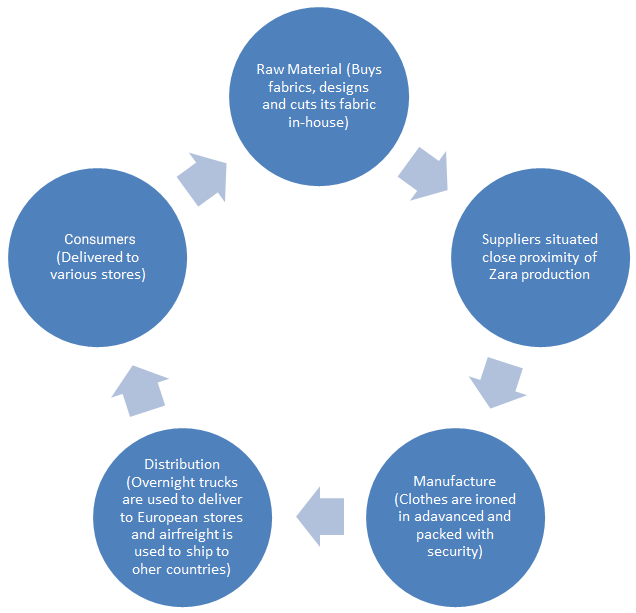
Zara possesses 90% for its stores in 88 countries including United States, Europe, Asia, the Middle East and many, and the rest is the joint ventures or franchises. It boasts in-house production factories within proximity for the headquarters (Hill, Jones & Schilling, 2014). It affords the company self-containment throughout the stages for its supply chain: raw material selection, production, distribution etc. Here is a graphical representation for the Zara supply chain for better understanding,
Supply Chain Management of Zara:
Zara’s strong supply chain management gives it a unique advantage over its rivals since it can handle any breakdown in the supply chain.

2. Adroit Design Strategy:

Traditionally, fashion companies use media in order to promote season’s trend. On the other hand, Zara is called “fashion imitator” because instead of for predicting trends, it imitates the trends of the season and provides such fashion trend to its customer at the minimum amount for time possible. Zara maintains a supply chain that enables them to embrace the fast-changing tastes for its customers. It introduces new clothing models within a few weeks only (Crandall, Crandall & Chen, 2014). It reacts quickly designs new styles, gets them into stores in a few days. Here are a few factors that play favor in company’s success,
  • Delivers new products twice each week to its stores, which adds up 10,000 new designs each year
  • Takes only 10 -15 days compared the to industry average for  6-9 months.
  • 12 inventory turnovers/year compared industry average 3-4 times

3. In-house production and no outsourcing:

Zara does not outsource its products in the hope for its reducing labor cost. Instead of outsourcing its work to cheap labor markets for Asia, it makes the most out for the cheap labor supply for Portugal and Galicia. This retailer giant is vertically integrated, unlike its competitors, H&M, Gap, Benetton, control its designs, and R&D facility production facilities, distribution centers, transport fleet, and 90% for its shops (Włodzimierz, 2012). When the company is paying for factory time in China, the company does not own the company, they are a number for uncertainties they will counter. It helps the company to reduce the cost for warehouses as shipping is done from production factories itself. Only, clothes with longer shelf life like T-shirts are outsourced to countries like Turkey, Bangladesh, etc.

4. Efficient Production Management:

Zara produces more designs than all its rivals. It launches around 12,000 new designs each year which is far more than what its competitors prepare (Wikipedia). Fast response to its customers’ demand enables Zara to meet customers’ expectations and ultimately leads it to success. Such demand management lacked in Marks & Spenser and to some extent with Sainsbury, they did not match their product with their customers’ expectations and this led the companies into trouble. Zara’s design-to-stock-cycle varies from 4 to 6 weeks compared to the average six months for the traditional industry. This reduced time enables Zara to introduce new designs in every week and change its product catalog in 3 to 4 weeks (Christiansen).

Zara Product Design Strategy

Zara commits six months in advanced to only 15% to 25% for a season’s line, which means it produces 50% for its clothes are designed and manufactured in the middle for the season. If trends change, Zara reacts quickly, designs new styles according to the new fashion trends. With the help for their efficient vertically integrated supply chain, they get the designs into the stores while the trends are still peaking.

5. Large Distribution network and greater Reach:

Zara has 2,200 stores in 96 countries and is the flagship brand for the Inditex Group (Forbes). The higher number for stores means greater distribution network and greater reach to the customers.
How Zara Become a Global Brand?
TimelineMilestone
1975Opened its first Zara Store in downtown A Coruna, Spain
1988 – 1990Opened first Zara store outside Spain in Oporto, Portugal, then expanding to New York (1989) and Paris (1990)
2002Introduced its new distribution hub in Zaragoza, Spain
2003Opened first Zara home outlet
2004Unveiled store in Hong Kong, expanding global footprint to 56 countries
2007Introduced first online store to global consumers
2010Opened its first store in Bulgaria, India, and Kazakhstan, increasing its presence to 77 countries, Inditex Group reached the 5000-store mark with the launch for a cutting edge, eco-efficient Zara store in the heart for the Rome, Italy.
2011Opened online Zara stores in the USA and Japan
2012Revamped image based on four principals – beauty, clarity, functionality, and sustainability.
2013Rolled out new brand images in their flagships and opened new high-profile stores such as Massimo Dutti at Rue de la Paix and Zara on the Champs-Élysées in Paris, Oysho and Zara Home in Shanghai and Pull&Bear in St Petersburg, among others.
2014Zara established a new logistic center in Cabanillas (Spain)
2015Reached 7000 stores milestone.
2016Named as group leader for the retailing industry in the Dow Jones Sustainability Index and top Greenpeace’s Detox Catwalk
2017Zara began selling through zara.com in India, Malasia, Singapur, Thailand, and Vietnam. It further increased the Zara Join Life sustainable collections and spread out this initiative to Massimo Dutti and Oysho.
(Source: /www.inditex.com/about-us/)

6. Strategic Locations of the Stores

Zara stores have been popping up all over the world. The company invests a handsome amount for money buying storefronts beside luxurious brands to own the label for luxurious brands. It chooses its locations very carefully to cater local customer by understanding their needs. They also follow tailored retail strategies to satisfy customers according to seasonal trends.

7. Affordable Prices

Owing to its affordable brand label, customers get to enjoy high-end fashion clothes at affordable prices. Zara’s apparel pricing ranges from $5 to $322, however, the average price point at Zara is $48. While comparing its prices with its one for the biggest competitor H&M, the differential pricing structures for these two brands can be noticed. H&M’s most priced bracket in tops is $20 – $30, whereas, Zara’s is $40 – $50. When it comes to discount strategies, these two brands follow very different approaches. H&M currently has 24.2% for their entire online offering on discount, with 9.3% discounted by 50% or more. In contrast to H&M, Zara only offers 3.2% for their online offering discounted, and only 0.2% for the offering discounted by 50% or more (Edited.com, 2016).

Weaknesses

1.Self-contained Distribution system prone to unpredicted problems:

The centralized distribution system is the biggest problem for Zara. If any technical snag occurs in the distribution network then the whole system can collapse. But in other apparel companies, the distribution networks are decentralized and not self-contained like Zara. As such even if one part for the network falls, there is no wholesale collapse for the entire network. Zara controls its production, suppliers, distribution system, retails stores, unlike its rivals that make it prone to unforeseen problems.

2. Imitator, not Creator:

The Fast Fashion strategy also has its own set for weaknesses. Zara can never be one for the premium luxury brands in the fashion world because it is considered as the great fashion imitator since it usually imitates runway fashion rather than predicting the styles for the season (Hansen, 2012). No doubt it provides its customers high-end designs, but its designers play smart a trick by copying designs for fashion week, rather creating some original on their own.

3. Spends Zero Revenue on Their Advertisement:

Zara does not spend much money on advertising. It has a zero advertising policy unlike its rival Benetton, H&M, and GAP (Hansen, 2012). However, some for the major names for the glamour world are the brand ambassador for these companies. One for the biggest marketing moments for Zara was when Kate Middleton wore Zara dress ($49.99) the day after her wedding to Prince William (Dailymail.co.uk, 2016). However, this zero ad policy gives its rival greater public exposure.

Opportunities

1. Scope for Global Expansion

Zara has global market penetration. The company has market presence in all the four major continents. However, it still needs more expansion in Africa and Asia. In Africa, it has stores only in Egypt, South Africa, Morocco, Tunisia, and Algeria. The company has more opportunities here. Africa has full potential stored for this company. Similarly, in Asia, countries like China and Japan have more stores than India, Singapore, UAE, and Saudi Arabia despite that fact that these countries have a substantial number for rich people.

2. More Attention to Distribution Network

Finally, a distribution network in the US needs to increase while keeping the basic elements in mind. Statistics projects that the huge geographical expanse for the US calls for a greater numboffor stores. A large population of US requires more stores to satisfy the needs for the growing customer base in the US.
AreaNo.of stores (ZARA)No. Of stores (ZARA home)
Europe1351390
Asia and the rest of the world553105
America30957

Threats

1. Fierce Competition

Zara experiences fierce competition, not only locally but also globally. Locally Zara faces competition from Sweden’s H&M and in-house brands like Massimo Dutti and Stradivarius, whereas, on the global platform, it faces competition with international brands such as in the US, the toughest competition is from the US-based GAP.

2. No Collaboration with International Designers:

Zara shares no collaboration with international designers unlike H&M, which has collaborated profitably with international designers like Karl Lagerfeld, Lanvin, and Alexander Wang. This can be a serious threat to the company. When a company collaborates with an internationally noted designer, young shoppers get interested in buying designer labels.

PESTLE Analysis

PESTLE, one for the most popular marketing tools, helps to analyze the external factors that affect an organization. PESTLE is mostly used when manager attempt to identify factors pose as threats to the organization or the opportunity that the company can use to climb the ladder for success. PESTLE is acronyms for six essentials factors,
  • Political factors refer to the policy for the government that involves legal and economic aspects
  • Economic factors mainly demonstrate the changes in taxation, inflation in economic growth, the rate for exchange and rates for interest.
  • Social factors mainly highlight any alteration in trends in society and its potential effect on the company’s consumers.
  • Environmental factors refer global situations like global warming, greenhouse effect, natural calamities, etc.

Government Intervention:

Whenever Zara plans to expand its roots to another country. It has to know the entire system before taking any permanent step. The reason is, the government for a country can easily change its policy, which will affect the company’s operation.

•British Riot Situation:

Whenever Zara plans to expand its roots to another country. It has to know the entire system before taking any permanent step. The reason is, the government for a country can easily change its policy, which will affect the company’s operation.

•Expanding Business in Europe:

Zara is planning to expand its business in the Europe Union because for its safe and prediction economic circumstances. It will help the company to predict its market growth because Europe economy rarely changes.

Economic Factors:

•Fluctuating Economy:

Zara has been witnessing fluctuation in the last few years, but it is drawing its revenues successfully for last years. The recession in 2011, has not affected the company as such. The reason is Zara deals in dollars and safer currency for its dealings. The company always evaluates the economic condition and currency rates for that country before entering its new markets (Knox, Agnew & McCarthy).

•Prices differences in various countries:

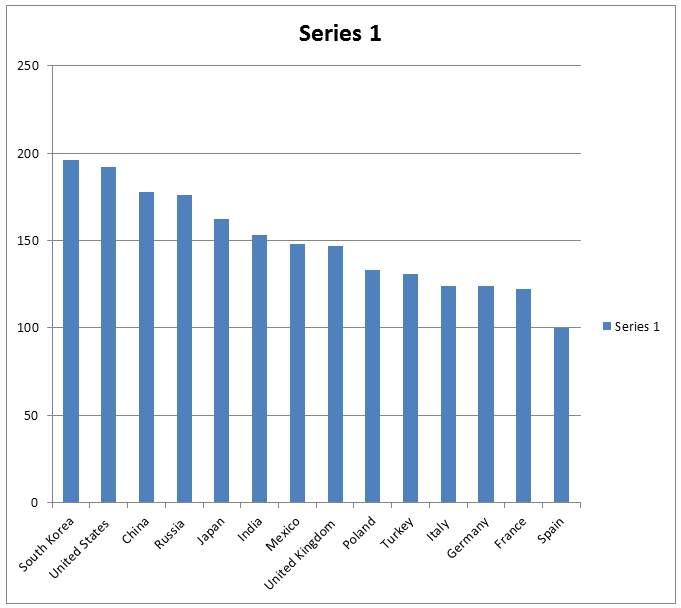
Due to different customs duties and the level for tariffs in various countries, the prices for Zara products vary in different countries. Here is a comparative study conducted by the newspaper El Confidential demonstrating pricing differences in various countries, 22% to 24% higher in France, Italy, and Germany.
Source – AlphaWise, Morgan Stanley Research, Zara websites (April 2015)

Social Factors:

•Sizes of Clothes 6 -16:

Keeping societal factor in mind, Zara creates its products while keeping the basic factors like geographical position, race, and origin for the country population. So you can find clothes for someone who is very skinny or for someone who is more heavyweight. It gives the company a societal advantage.

•Discounts and offers:

It is in our habit to incline to perceive add-ons such bonus packs as gains so as for price discounts. Zara provides promotional codes, vouchers and offers deals to its customers. Zara promotes its products by various coupon sites where one can find its discount codes, which can be redeemed at their online shopping site or store.
Technological Factors:

•Launching Apps for Feasibility of Customers:

Zara tactfully uses information technology to support its international logistics system and an online store where exchange and return for products are involved. Zara gives its customers the chance to buy its products by iPod and in-house apps (Forbeswelcome, 2016).

•Interactive Maps to locate the store:

Zara projects a store locator on the website where you can easily locate a store by entering your desired region and location. The store locator will show you the closest stores around the entered location. Hence, it gets easier for the consumers to discover stores as the online maps show the exact location for the store.

•New Experience with Zara iPad app:

Zara’s attempt in online shopping is revolutionizing the entire online buying experience. With just a few clicks on your iPad’s Zara online shopping app, you will now be able to conference with your friend while looking at the clothes on your tablets. This technology gives any buyer the opportunity to involve their friend’s suggestions while shopping for their own. The options like video chat, instant messaging and voice chat are available (Thestir.cafemom.com, 2016).

Environmental Factors:

•Earthquake in Japan

A series for disasters struck Japan in 2011, the tsunami was one the biggest one that devastated Japan in many ways. For the apparel industry and its supply chain, the short-term impact can affect organizations in long term. Damage to local infrastructure, power irruptions, closed ports are a few ones among the problems that the apparel industry faced during this time.

• Asian Countries require rapid fashion change:

Weather in Asian countries is totally different from European countries. Five extreme seasons rule the weather, whereas winter rules in European countries. Variation in seasons requires rapid fashion change based on the local weather. Instead for focusing on seasonal changes, Zara sells clothes for the normal weather.

•Litigation changes in different countries:

The government for Russia, India, and Mexico provide their own version for corporate policies, and the company has to alter operation according to the set policies. In this manner, the pressure is always on the Zara products in teroffor ensuring that they are following proper litigation in their business operations.

•Copyright Issues:

Big fashion retailers like Zara value their brand equity because they develop a bond with their customers through their brand names and trademarks. But sometimes, it becomes impossible for the organization to implement copyright law. Moreover, in many instances, the company itself faces a number for copyright issues, the recent one with global brand Fendi. Roman fashion brand Fendi claimed that Zara had unlawfully used their photographs that had been taken from Fendi’s show in the 2013 fashion week.

Conclusion:

It might be said that Zara has the potential to be the largest clothing retailer in the world. However, fast fashion policy must also go hand in hand with aggressive marketing using all modes for marketing channels. Distribution network must expand especially in Africa and America to get the maximum exposure for the brand. After assessing its internal and external factors, it is noticed that Zara manages to stay up at the revenue growth due to its unique and strong model for the business. It is advisable that the company should continue to launch creative and fresh fashion to satisfy the needs of the customers.
Based on the SWOT and PESTLE analysis, Zara will stay as the leader in the apparel industry in spite for the challenges and threats it would face. Its unique supply chain infrastructure and efficiency for the business operation give the company the competitive advantage, which reflects in their sales and revenues
visit at: ACS code of ethics
https://thebestassignmenthelp.com/the-best-assignment-help/

Grey Teak Technology Of Australia

Grey Teak Technology Of Australia

Question:

Write a report about the Grey Teak Technology of Australia.
Answer:

Introduction

The report highlights some for the main features for the website for the company Grey Teak Technology of Australia. The head office for the company Grey Teak Technology has situated in city Melbourne of Australia. The company mainly deals with the development of software for its clients. The company has launched a new website for their design studios. The company has created the website in a way that would draw the attention of almost all the people who are interested in the services for the company. The website for the company claims that the company provides secure and robust systems for ground up. The website also draws the attention of the people to the fact that the expert team for the company develops efficient software as per the requirements of their clients. The website also claims that reliability is one of the several reasons why the clients for the company choose them over all other software developing firms (Greyteak.com.au 2016).
Some for the salient features for the website include that the website generates a clear idea in the minds for the people about the works that the company Grey Teak Technology does. The homepage for the website for the company contains the list for the services that the company provides. Some for the services include the following:
  1. Development for software for the enterprises.
  2. Management for systems and applications.
  3. Development for the system design.
  4. Advance development for websites.
  5. Improvement of the business process
  6. Services for the maintenance for the websites.
Apart from the list for the services that the company provides, the website also gives a brief overview for some for the information about the company. The website acquaints its users to the company profile. Moreover, people can access the contact details for the company through its websites (Hsu et al. 2012).
Some for the positive aspects that one can notice about the website for the company are that the company can reach a wider range for its clients through this website. Secondly, anyone can access the website from anywhere of the world and at any time. The users for the website can easily access all the information related to the business for the company. The company can use the website for the purpose of publicity and for advertising their product or new software (Kim and Lennon 2013). Some of the negative aspects associated with the website are that the clients of the company may consider the information given in the website to be unreliable. This happens when the company does not update the information on the website from time to time. There can be other related issues like the crashing of the website or the problem of spam (Ionescu and Serban 2012). The company has presented the website in a very efficient format. The clients of the company can easily use the company’s website. The clients find it very easy to interact with the managers of the company through the website. Hence, this adds to the positive side of this website.
The company Grey Teak Technology for Australia has passed through different phases before launching the new website for the company. The website launch has undergone the exposure stage and the interaction stage. The stage for exposure to the website for the company includes the planning for the launch for the new website. At this stage, the board for directors holds meetings and discussions regarding the launch for the new website. The interaction stage follows the exposure stage. The website for the company is in the e-commerce stage. The company conducts its trade and business online through the website (Sozinova and Fokina 2015). Looking at the services that the company provides to its customers and to other business organizations, one can conclude that the website for the company is in the e-commerce stage.
The website for the company requires hardware and software like all other websites. The estimation for the minimum requirement for hardware for the website for five users using the website at the same time should consist of the following:
  • Minimum space for the database needs to be 10GB.
  • CPU should have Intel Core 2
  • RAM should be for 2GB.
For twenty-five concurrent users, the hardware requirements consist of a 4GB RAM with a minimum database for 10GB (Kendall et al. 2014).
Similarly, the software requirements for the website would include the operating systems, the web browsers, the networks, firewall configuration, prerequisite packages and directory, and environment configuration script (Bonarini et al. 2014).
E-commerce generally comprises for the selling for the services and products online. The strategy to implement e-commerce contains many elements that are separate and unique from each other. E-commerce demands a sophisticated system for content management. To start with the e-commerce system, one can see that e-commerce requires a dedicated system for payment, purchase and support system. E-commerce also demands strong procedures for managing the relationship with the customers. A sound effort for marketing is also very important with respect to the implementation for e-commerce. The company requires a professional and good quality website that demands careful management and development (Chen et al. 2013).
Before implementing e-commerce, the owner for the website should keep in mind the following points;
  1. E-commerce is not always suitable and appropriate for selling every product and services.
  2. E-commerce is quite complex. The owner may need to spend a lot on money to get the things right about e-commerce. It is not very easy to design and manage an e-commerce website efficiently.
  3. The “clicks and mortar” approach seems to be the best in implementing the e-commerce website. The approach combines traditional retail resources with online options (Gangeshwer 2013).
There are some products present in the market that are very well suited for e-commerce. Digital products such as the information and software are the top-ranked e-commerce product. Some other products that are suitable for the e-commerce market are the products with higher values as compared to their cost for fulfilment, products that people do not find easily in stores, products that people find easier to buy online than from stores, products that people do not need to try while buying (Ionescu and Serban 2012).
Here are a few strategies that the author for this report wants to suggest to the owner for the website to implement the e-commerce:
  1. The owner first needs to understand the scope of his intentions. The owner needs to plan his strategies for implementing e-commerce well in advance.
  2. The owner needs to manage the inventory, payment, sales fulfillment and security.
  3. The owner needs to be efficient to integrate the e-commerce website with the rest for the ventures for the business.
  4. The owner needs to mention on the e-commerce website that the company is ready to sell their software to all the other countries outside their own country Australia. This would fetch the customers from all over the world. To accomplish this, the owner needs to have a clear knowledge for exporting the services and products.
  5. The owner for the website should offer the e-commerce services first to the existing customers for the company. This would help the owner to gradually increase the market for the e-commerce website (Perrigot and Pénard 2013).
The author for the report feels that following the above-mentioned strategies, the owner for the website can successfully implement the e-commerce model to earn more profit.
The software requirement for e-commerce website has become more streamlined and developed. The software required for e-commerce is not very cheap, neither it is easy and simple to run everything smoothly. Hence, the degree for difficulty increases with e-commerce websites. Some for the software required by the e-commerce website includes a web server such as Google Chrome, Windows internet explorer, Opera. Some for the home server software includes Apache, FreeNas, and Debian. The computer must have a unique IP address (Kendall et al. 2014). The hardware requirements for high traffic e-commerce sites and low traffic e-commerce depends on different factors. One can run the low traffic e-commerce websites on single machines that depend on the needs of the business. Pentium II or III with Intel server that runs Linux is capable for serving over hundreds for customers of the company in each day (Bonarini et al. 2014). Conclusion
The report describes the features for the website that the company Grey Teak Technology in Australia has launched recently. The report highlights both the positive and negative sides and the usability aspect of the company’s website. The report also provides a guideline to the owner for the website for implementing the e-commerce model. Hence, with the help of the report, one can get a clear idea about the implementation and launching for an e-commerce website.  References:
Bonarini, A., Matteucci, M., Migliavacca, M. and Rizzi, D., 2014. R2P: An open source hardware and software modular approach to robot prototyping.Robotics and Autonomous Systems, 62(7), pp.1073-1084.
Chen, P.W., Lin, W.Y., Huang, T.H. and Pan, W.T., 2013. Using fruit fly optimization algorithm optimized grey model neural network to perform satisfaction analysis for e-business service. Appl. Math, 7(2L), pp.459-465.
Gangeshwer, D.K., 2013. E-commerce or Internet Marketing: A business Review from the Indian context. International Journal of u-and e-Service, Science and Technology, 6(6), pp.187-194.
Greyteak.com.au. (2016). GreyTeak Technologies – The Best, Professional Logo design, Web design and Systems development company in Melbourne, Australia.
Hsu, C.L., Chang, K.C., and Chen, M.C., 2012. The impact for website quality on customer satisfaction and purchase intention: perceived playfulness and perceived flow as mediators. Information Systems and e-Business Management, 10(4), pp.549-570.
Ionescu, A.A., and Serban, R., 2012. Presentation for various types for electronic business available on the Internet, Advantages, Disadvantages, Key Requirements and Security, Implementation Model for an Electronic Business. International Journal for Economic Practices and Theories, 2(3), pp.179-196.
Kendall, K.E., Kendall, J.E. and Wasson, C.S., 2014. Systems analysis and design (Vol. 19, p. 02). Year Prentice Hall, 2011.
Kim, J. and Lennon, S.J., 2013. Effects for reputation and website quality on online consumers’ emotion, perceived risk, and purchase intention: Based on the stimulus-organism-response model. Journal for Research in Interactive Marketing, 7(1), pp.33-56.
Perrigot, R. and Pénard, T., 2013. Determinants for e-commerce strategy in franchising: a resource-based view. International Journal for Electronic Commerce, 17(3), pp.109-130.
Sozinova, A.A. and Fokina, O.V., 2015. Special aspects of studying the internet as a marketing communication channel for the service industry.Mediterranean Journal for Social Sciences, 6(4), p.139.
visit at: Zara Canberra assignment help
https://thebestassignmenthelp.com/the-best-assignment-help/

Sunday, February 3, 2019

BACKLINKS


MKT703 SAMPLE

                        MARKETING AND STRATEGY Table of contents   Introduction ................................